
Regional Homelessness Updates
We serve Adams, Arapahoe, Boulder, Broomfield, Denver, Douglas, and Jefferson Counties
Categories
All | Coordinated Entry | Funding | HMIS | PIT Count | Press Release | Regional/BFZ | Reports | Training
Key Takeaways from the 2nd Regional Convening on Homelessness
On April 5, 2022, leaders from across the state gathered to support the ‘Built for Zero’ framework for ending homelessness.
On April 5, 2022, leaders from across the state gathered to support the ‘Built for Zero’ framework for ending homelessness. This year’s convening focused on the regional and local progress made towards ending veteran homelessness, as well as opportunities for collaboration and lasting change. This event was sponsored by MDHI, Community Solutions, the Metro Mayor’s Caucus, Veterans Affairs, Metro Area County Commissioners, and the CO Division of Housing.
“I called HUD VASH again and they told me to go to the Beacon house. So I went to the Beacon house and I asked them if they could let me stay there for a couple weeks until my apartment was ready. They said ‘yes, that’s what we do.’ It’s kind of a cliché. You know, you guys always say ‘that’s what we do.’ And I believe that now. You guys do an excellent job.”
Built for Zero – The Framework
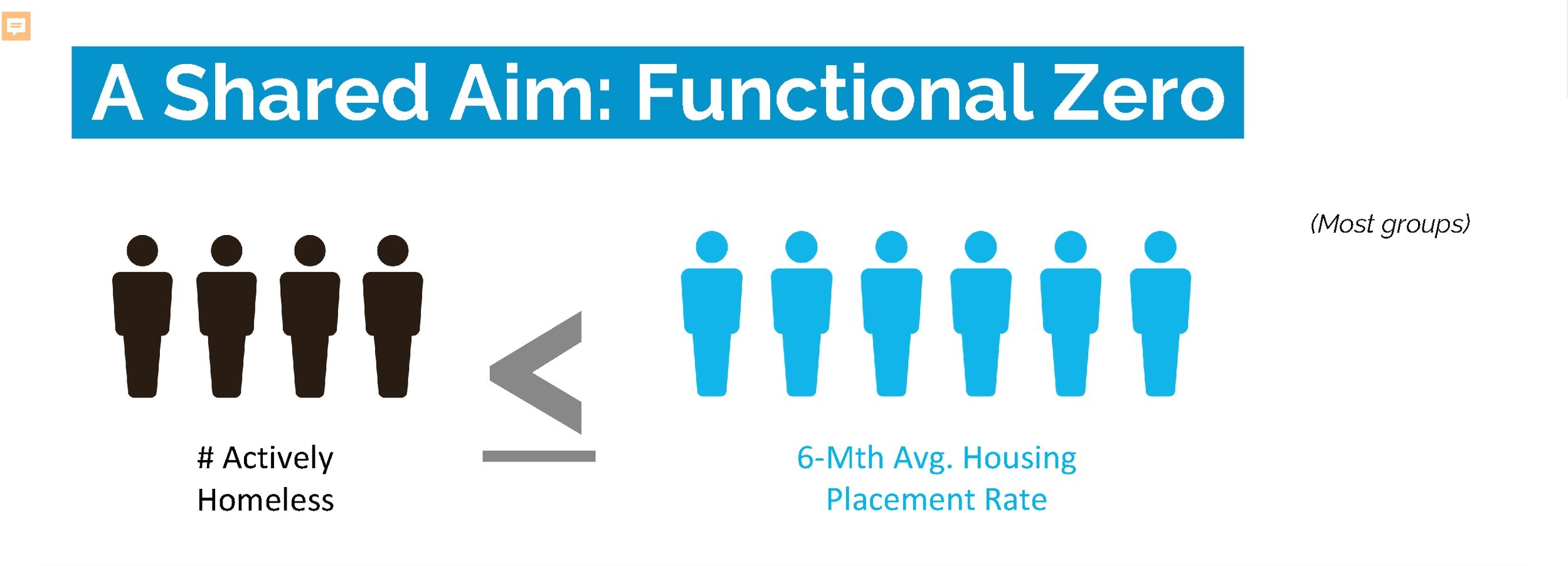
When we approach homelessness as a solvable issue, we shift from attempting to manage the problem to creating a system that ensures homelessness is a rare, brief, and one-time occurrence. Built for Zero is an operating system that aligns quality, real-time data, local planning, and regional coordination around a shared, measurable aim: ending homelessness. This end is measured by ‘functional zero,’ which happens when a community is housing more people than the number of actively homeless per month.
Metro Denver’s Subregional Approach
“In order for us to be successful we have to absolutely acknowledge that this is a regional issue that no city or county can resolve the enormous challenge of homelessness that is the most complex public policy issue any of us will ever face alone. So I am grateful that we have been able to come together and make the progress under this framework together. Let me simply say thank you to all of our regional partners for leaning in. I’m excited about the opportunities that are in front of us because of our regional collaboration… I’m grateful and I’m absolutely energized by our collaboration and by the progress that’s being made under the Built for Zero framework. ”
MDHI is coordinating the Built for Zero work as the region’s Continuum of Care. However, our regional strategy relies heavily on local planning in order to meet the diverse needs of each community. These subregions include the seven counties (Adams, Arapahoe, Boulder, Broomfield, Denver, Douglas, Jefferson), the Tri-Cities (Englewood, Sheridan, Littleton), and Aurora.

Local Structure
Each subregion is working on the following steps to achieve functional zero:
Complete the BFZ Scorecard
Create a Local Structure (with Veteran Case Conferencing)
Finalize the Veteran By-Name List
Assure Quality Data
House More Vets than on the By-Name List = Functional Zero
Move onto Another Subpopulation
This approach is working! In fact, while all other types of homelessness have increased due to the economic impact of COVID-19, Veteran homelessness has decreased by over 15% since the beginning of 2021. This is encouraging news. Our region is at a point where we know Veterans experiencing homelessness by name and are working to meet their individual housing and stability needs. Some communities, sparked by this momentum, have already begun applying this framework to other subpopulations, such as chronically homeless individuals, families, and youth.
Proposed Homelessness Initiatives
Metro Denver’s strategy requires a robust continuum of response to meet the diverse needs of people experiencing homelessness. The State of Colorado is focused on supporting communities in creating this continuum of proven solutions designed to connect people without stable housing to supportive services, behavioral health, medical care, and housing. The Governor’s budget submission requests $200M from the $700M Economic Development and Relief Funds for community investments in homelessness response. These proposals include:
-
Support investments in community-based continuum of services and supports for people at risk of or experiencing homelessness with complex needs (including behavioral health needs), including: Emergency shelters, Transitional housing, Recovery care and related residential programs, Permanent housing with wrap-around services
Grants will be issued for innovative programs that meet the needs of individuals experiencing or at risk of homelessness. Collaborative partnerships with matching funds from local governments, philanthropy, and private partners are expected.
-
Similar to the Fort Lyon and proposed Ridge View supportive community models, a Denver-area supportive residential regional campus that leverages additional resources and integrates a continuum of services and supports to address physical and behavioral health while provided safe space for recovery
-
Ridge View Youth Services Center is a high quality state owned asset
Provides opportunity to expand upon lessons learned at Fort Lyon Supportive Residential Community in Bent County
Goal is to Invest in a supportive community model that integrates a continuum of recovery oriented services and care (e.g. detox/withdrawal supports), transitional housing, vocational rehabilitation, and oral, physical, and behavioral health services
-
Why:
Data to understand the need and whether we are reducing the number of people experiencing homelessness.
Understanding who is experiencing homelessness and what their needs and barriers are is critical to informing strategies and creating an efficient coordination of resources.
Aim:
Increase capacity across the state to locate, identify, and engage anyone living unsheltered
Increase capacity to improve the data collection of that effort as well as data from homeless programs
Together, these efforts will enhance our collective and accurate knowledge of who is experiencing homelessness and be that bridge to connecting the services and housing.
How:
Fund community-based organizations to hire outreach staff who coordinate with existing efforts that engage people living unsheltered. They will ensure an accurate list is created and engage individuals to assess needs to connect to care and housing.
Fund the Continuum of Care entities to increase Homeless Management Information System utilization.
The American Rescue Plan Act of 2021 (ARPA) also created an additional $1.3 billion of funding for Colorado to improve access to affordable housing and supportive services for people that were disproportionately impacted by COVID.
-
Gap financing (5-7.5%)
Maintain existing affordable housing (4.5-6.5%)
Governor’s priority: Green Energy for AH
-
Gap financing (5-7.5%)
Maintain existing affordable housing (4.5-6.5%)
Sustainable rental assistance (4-6%)
Governor’s priority: Strong Communities
Governor’s priority: Green Energy for AH
-
-
-
Behavioral Health Transformational Task Force and Task Force on Economic Recovery Relief Cash Fund may provide $254M
-
In combination with Governor’s priority: Innovative Housing Incentive Program
-
Policy Recommendations
Creating a well-funded, data-driven homeless response system is simply not enough. Our region needs comprehensive legislation to address the lack of accessible affordable housing so we can treat this problem at the source.
The following Bills are being considered by the House and Senate in this legislative session to address homelessness and affordable housing:
HB1304 - State Grants Investments Local Affordable Housing
SB159 - Revolving Loan Fund Invest Affordable Housing
SB146 - Middle Income Access Program Expansion
HB1282 - Innovative Housing Incentive Program
HB1051 - Modify Affordable Housing Tax Credit
SB160 - Loan Program Resident Owned Communities
HB1083 –Colorado Homeless Contribution Tax Credit
The 2022 Pledge for Elected Officials
“Knowing that issues facing our region do not recognize county lines or city lines, it’s important that our work is collaborative to help address housing, transportation, poverty, and economic development. This year the Metro Area County Commissioners have decided to focus our efforts on identifying regional strategies to support our neighbors that are experiencing homelessness.”
We ask our state and local elected officials to sign this pledge and maximize our region’s progress toward ending homelessness.
In metro Denver, we have a shared goal of making homelessness, rare, brief, and non-recurring. We understand that there are many paths to homelessness including high housing prices, stagnant wages, domestic violence, disability, chronic conditions, and mental and behavioral health challenges. We are committed to addressing these core issues in an equitable manner to ensure that homelessness is not a destination, but rather a low point on the path toward a better future. To this end, we pledge to work together and exercise leadership to:
Build on our success from year one of Built for Zero which reduced veteran homelessness by 15% despite rising rates of homelessness nationwide;
Use the shared Homeless Management Information System or “HMIS” database that enables us to better serve our neighbors experiencing homelessness regardless of their location in the region;
Tailor our interventions and methods to reflect peer-reviewed best practices;
Collaborate regionally to maximize our investments in housing, treatment, and other critical resources.
Join Our Board, Make An Impact
Our Board is recruiting diverse candidates for the term beginning July 1, 2022. Applications are due April 25th.
Our Board is seeking new members to help us shape the future of MDHI. Applicants with diverse professional, educational, ethnic, racial, gender, and socioeconomic identities are encouraged to apply, as well as people with lived experience of homelessness or housing instability. You must live in the seven-county Metro-Denver area (Adams, Arapahoe, Boulder Broomfield, Denver, Douglas, and Jefferson Counties) and have a passion for addressing homelessness in your community.
Metro Denver Homeless Initiative’s mission is leading and advancing collaboration to end homelessness in our region. The role of MDHI is to provide data, support, and coordination on the issue of homelessness and housing instability. The Board is critical in shaping the policies and strategy for MDHI as both a nonprofit and a Continuum of Care.
We are currently accepting Board applications for the term beginning July 1, 2022. Applications are due April 25th and can be found here. The Board meets on the 2nd Tuesday of the month from 5:30-7:30 pm.
To learn more about our Board, visit our Board page. Please email any questions to info@mdhi.org.
2022 Regional Convening on Homelessness
Please join us on April 5th from 8:30-10:00 AM MST for the 2022 Regional Convening on Homelessness! Learn more about what our region’s accomplished and the work that still needs to be done.
2021 Regional Convening on Homelessness
Last year on March 18, MDHI coordinated the Regional Convening on Homelessness with key leaders from across the state to harness our collective influence, learning, and efforts to drive reductions in homelessness together. This convening sought to align the local efforts of mayors, county commissioners, city council members, and city managers from the seven-county metro-Denver region, along with our private sector, regional, and national partners.
A lot of progress has been made since we launched our Regional Coordination strategy. Since then, the nine subregions have been working diligently to establish the Built for Zero framework in their local communities, starting with Veteran homelessness. This approach is working! In fact, while all other types of homelessness have increased due to the economic impact of COVID-19, Veteran homelessness has decreased by over 15% since the beginning of 2021.
This is encouraging news. Some communities, sparked by this momentum, have already begun applying this framework to other subpopulations, such as chronically homeless individuals, families, and youth. Our region is at a point where we know Veterans experiencing homelessness by name and are working to meet their individual housing and stability needs. It’s now time to take our Regional Coordination strategy to the next level.
2022 Regional Convening on Homelessness
Please join us on April 5th from 8:30-10:00 AM MST for the 2022 Regional Convening on Homelessness! The event be live-streamed on Facebook and later posted on Youtube.
Here's what to expect at the second Regional Convening:
Update on the State of Homelessness in the region
Overview of the Built for Zero framework, celebrating the milestones and success in our region
Progress on your community's Built for Zero Scorecard
Analysis on where gaps and challenges still exist locally
Call to action for you to support this work
Brought to you by:

Flex Fund Updates
With your help, Flex Fund was able to assist 286 households with $428,597 in landlord mitigation, move-in, and prevention assistance in 2021. Learn more about our success, as well as changes to our 2022 Policies & Procedures.
With your help, MDHI’s Flex Fund was able to assist 286 households with $428,597 in landlord mitigation, move-in, and prevention assistance in 2021. This is huge, and we could not have done it without continued support from our donors and participating agencies.
We want to alert you of some upcoming changes to MDHI’s Flex Fund for the new year. Interested and participating agencies should review the updated MDHI Flex Fund Policies and Procedures 2022 to remain up to date on our latest procedures and eligible costs. These changes will go into effect on February 1st, 2022.
Please do not hesitate to reach out with any questions. Thank you for the work you do!
Elizabeth Harms
Housing Stability Coordinator

Annual ‘State of Homelessness’ Report Released
Read the 2nd Annual State of Homelessness Report released January 20, 2022.
MDHI Releases Second State of Homelessness Report
DENVER, COLORADO – January 20, 2022 – The Metro Denver Homeless Initiative (MDHI) released its second annual State of Homelessness report today, highlighting new data in the region related to homelessness.
The report, for the second year in a row, demonstrates the overall issue of homelessness across multiple sources including the region’s Homeless Management Information System (HMIS), the 2021 Point in Time (PIT) count for those staying in shelter, as well as school district data on students experiencing homelessness.
The HMIS showed 32,233 individuals accessed services related to homelessness between July 1, 2020, and June 30, 2021. Additionally, there is data from the HMIS on those staying outdoors or other places not meant for human habitation, commonly referred to as unsheltered.
Consistent in this year’s report as compared to last year is the overrepresentation of BIPOC individuals in the population of those experiencing homelessness. “While there are differences in counts and definitions across the data sources, one thing remains glaringly consistent – racial inequity,” stated Jamie Rife, Director of Communications and Development at MDHI who will be filling the organization’s Executive Director role on February 1.
Also included in this year’s report is further information on the region’s unsheltered population. Over the course of a year, 10,870 adults, 1,031 members of families, and 954 youth engaged in services while staying in an unsheltered location. “For the first time, our region is beginning to get more real-time data, including on those staying outdoors,” said Rife. “While the last full Point in Time count in 2020 showed 1,561 individuals staying in an unsheltered location, what we see now is that over the course of a year, this number is 12,855.”
In 2020, the last time a full Point in Time (PIT) count was conducted due to safety concerns related to COVID, it identified 6,104 people experiencing homelessness on a single night. The 2022 PIT is scheduled for Monday, January 24 and will include a full count of both those staying in shelter and those staying in unsheltered locations.
Also included in the report are implications as well as information on successes in the region. “While homelessness continues to climb for many, the region has seen a 15% decrease in the number of veterans experiencing homelessness, in part due to the regional coordination and the incredible work done by providers in our region, as well as the enhanced resources available,” added Rife. “This is proof of the strides we can make when we work together and have more housing and services available for those experiencing homelessness.”
MDHI Names New Executive Director
Dr. Jamie Rife named next Executive Director, beginning February 1, 2022.
Dr. Jamie Rife to Serve as Next Executive Director
DENVER, COLORADO – January 10, 2022 – The board of directors of the Metro Denver Homeless Initiative (MDHI) announced today that Dr. Jamie Rife has been selected to serve as the organization’s next Executive Director.
After launching a national search in September of 2021, the board of directors of MDHI announced today it has selected Dr. Jamie Rife, who currently serves as the organization’s Director of Communications and Development, to be the next Executive Director.
The interview and selection process spanned several months and included input and feedback from community stakeholders, partners, and staff. “We had an incredibly talented pool of candidates from across the country,” said Mike Malloy, Board President. “Ultimately, we felt Dr. Rife was the best candidate not only for MDHI as an organization but for the work to end homelessness across our region,” he added.
Dr. Rife has served as the organization’s Director of Communications and Development since February of 2020. Previously, she spent over 15 years in public education where most recently she served as the State Coordinator for the Education of Homeless Children and Youth at the Colorado Department of Education. Dr. Rife conducts research on poverty and homelessness and is the co-author of the book “Journeys out of Homelessness: The Voices of Lived Experience.”
“We look forward to the knowledge, experience, and vision Dr. Rife will bring to the organization,” said Malloy. Dr. Rife will begin this new position on February 1, 2022.
2022 Point in Time Information
The 2022 Point in Time count is the evening of Monday, January 24th. Find out how the 2022 Point in Time will occur and which portions of the region are currently seeking volunteers.
The 2022 Point in Time Count will take place the evening of January 24 (into the morning of January 25). The following is how the region will successfully complete this year’s count.
Volunteer Opportunities
Due to different portions of the region being under different and unique COVID-19 protocols, the local planning teams in each of the regions (Adams, Arapahoe, Boulder, Broomfield, Denver, Douglas, Jefferson Counties and the City of Aurora) will determine the volunteer recruitment and signup process. As these are determined, information, by community, will be posted below.
All volunteers will be required to attend a virtual training to participate in the Point in Time. At the end of the training, each volunteer will certify they have taken the training as required by HUD. Each county plus Aurora will have additional information, including local COVID protocols, to provide for volunteers to safely and effectively conduct the count
Link to Maps:
Maps for Count - Census Tracts
Here is the current information available by community on how YOU can get involved:
Adams County Community Safety & Well-Being is seeking volunteers to help with the 2022 PIT Count, held on January 24th, 2022. During this one day census count, volunteers will interview persons experiencing homelessness using a standardized app-based survey that's designed for easy access on your smart phone. The PIT is critically important to understanding the needs and characteristics of unhoused residents in Adams County and the larger metro region. We can't collect this important data without the help of community volunteers! Please complete this form if you would like to volunteer. Contact Heather McClure hmcclure@adcogov.org (720) 523-6942 if you have any questions. Thank you! Please visit here to learn more and sign up.
Arapahoe:
Boulder:
Broomfield:
As many of you know, the annual Point-in-Time (PIT) count will take place through the week of Jan. 24, with emphasis on an observational count across the city at the beginning of the week (4 - 10 a.m. on Tuesday, Jan. 25). The observational portion of the count requires the strongest support from staff, partners, and volunteers.
Register HERE for Denver’s Count!
Douglas:
WHEN: The 2022 PIT Count begins on Mon., January 24th and continues for 24 hours, through Tues., January 25th. We have four different shift options.
WHERE: Volunteers will be deployed throughout Jeffco based on the geographic preference selected on the registration form.
Contact kbarker@jeffco.us with questions!
Register HERE for Jeffco’s Count!
City of Aurora:
Background on the Point In Time (PIT)
In 2021, the Metro Denver Continuum of Care applied for and received a waiver from HUD. This allowed the region, due to safety concerns related to the COVID-19 pandemic, to not count those staying in unsheltered (outdoors, other places not meant for human habitation) situations. A full sheltered (safe haven, transitional housing, and emergency shelter) count was conducted in 2021.
For 2022, the following protocols will be followed:
Sheltered Count
Similarly to 2021, the region will count the number of people staying in safe haven, transitional housing, and emergency shelter on the overnight of January 24th. This data is collected either via the region’s Homeless Management Information System (HMIS), for those that use HMIS, or via a mobile survey from staff at those agencies that do not currently use HMIS. For those using HMIS, this data will be pulled from the system on January 25th for those staying in shelter the night before (the overnight of January 24th).
Unsheltered Count
Given the historic conditions under which this count is being conducted, each of the seven counties in the region plus the City of Aurora will be choosing one of the two following approaches to conduct the count that best fits the needs and current conditions of their community:
Full Census Day of Count: In this approach, the community will seek to count and complete a full demographic survey (census) of everyone experiencing unsheltered homelessness in approximately a 24-hour period beginning the evening of the 24th into the 25th to determine where people were sleeping on the night of the 24th. This approach is suggested for communities with small to medium populations of those experiencing homelessness.
Full Observation and Sampling: In this approach, the community will seek to count visually all those experiencing unsheltered homelessness in a 4-8 hour window sometime between sundown on the 24th and morning of the 25th. In the week or so following the 25th, the community will collect a representative sample using the same survey as the Full Census of those experiencing homelessness to determine demographic information. Results from this representative sample will then be imputed and extrapolated to determine the full demographics of those experiencing homelessness in the community. This approach is suggested for those communities with medium to large populations of those experiencing homelessness.
MDHI received this update from HUD on January 10, 2022.
Thank you for your tireless work to protect people experiencing homelessness from COVID and working to prevent and end homelessness. Some CoCs have asked us about the status of the 2022 Point-in-Time (PIT) Count and Housing Inventory Count (HIC). We do not plan to cancel or postpone the 2022 HIC and PIT count. We recognize that in some communities, COVID is causing severe challenges with implementing an unsheltered PIT count. Please review the safety guidance posted on HUD.gov.
Holiday Schedule
We’re taking some time off this holiday season. See how we’ll be operating for urgent requests.
Dear Friends,
It’s the holiday season!
With that, we wanted to let you know that MDHI will be closed from December 23rd until December 31st to assure our staff gets some much-needed, quality time with loved ones.
Here is information on how we will respond to time-sensitive requests during this holiday break. Thank you for your understanding on delayed responses of non-emergency requests.
HMIS Help Desk
The HMIS Help Desk will only be monitored for HMIS lock outs or system failures. Any requests for training or non-urgent technical support will be answered when we return to the office on January 3rd.
OneHome
Any urgent OneHome requests during this time should be emailed to contact@onehomeco.org.
Housing Stability Flex Fund
The Housing Stability Flex Fund will also be responding to urgent requests only. We can approve urgent requests, but we will not be able to process checks until we return on January 3rd.
From our staff to you, thank you for your support during 2021, and we look forward to what we can accomplish together in 2022! Wishing you a joyous holiday season.
-The MDHI Staff
Final NOFO Priority List and Con App
Here is the final version of the 2021 NOFO Priority List for the CoC as well as Con App.
Within Reach Campaign
Housing is WITHIN REACH this holiday season!
Make a direct impact this season through the Within Reach Campaign!
The Metro Denver Homeless Initiative’s Housing Stability Flexible Fund directly houses individuals in our community. This fund was created by the Metro Mayors Caucus and has housed hundreds of our neighbors because we understand flexible funds are paramount to ending homelessness. Our goal this season is to assist 50 households by either staying in their home or moving into a safe stable place to call home.
Here’s the full information:
Metro Denver Homeless Initiative Launches
"Within Reach” Campaign to House 50 Families
[Denver, CO- (Nov. 4)]: The Metro Denver Homeless Initiative (MDHI), the region’s Continuum of Care tasked with coordinating a regional response to homelessness, will be launching the MDHI Within Reach Giving Campaign. The Campaign will run November 9th-December 31st, 2021 as has a goal of housing 50 families.
This campaign to support the organization’s Housing Stability Flexible Fund is designed to remove the last financial barrier that prevents a household from obtaining or remaining in permanent housing. MDHI works with over 80 local organizations to provide one-time emergency funds to households facing a housing crisis. When all other funding has been exhausted, the Housing Stability Fund steps in.
“Without the Housing Stability Fund, hundreds in our region would have fallen into homelessness or remained unhoused over the past three years,” said Jamie Rife, MDHI’s Director of Communications and Development. “This is literally a fund of last resort when all other avenues have been exhausted by a household’s case manager.”
The Housing Stability fund is made possible from strong and consistent support from the Metro Mayors Caucus, the Denver Foundation, Mile High United Way, Wells Fargo, and private donors.
The goal this winter is to raise $75,000 for households in crisis. This will help 50 families either stay in their homes or secure housing. To reiterate, households must be literally homeless to at-risk of becoming homeless to be eligible for this emergency assistance. Funding is issued to the appropriate third-party vendor, such as a utility company, landlord/property owner, moving company, etc. MDHI is not able to approve requests directly from households themselves; all requests are made by organizations that partner with MDHI on behalf of their clients.
All assistance is tracked through the region’s Homeless Management Information System (HMIS) to ensure there is not duplication of services or requests for the client. MDHI works directly with landlords and other third parties to provide the necessary assistance.
“In some cases, we’ve seen as little as $57 that’s keeping a family from a home. This Fund helps remove those last few barriers,” shared Rife. “With the holidays quickly approaching, we’re asking for the community’s support in providing hope in the form of housing this season.”
Housing stability is Within Reach and MDHI needs your support! To donate, visit MDHI.org/donate All donations received between November 9 and December 31 will go directly to housing households in need.
Consolidated Application Input & Office Hours
MDHI is looking for your feedback on the annual Consolidated Application!
It’s time to submit the annual NOFO to HUD and we need your input! Here’s the most current draft of the document where you can add comments, suggest changes, and share any work MDHI hasn’t captured in this draft. Changes are due by 5 pm on November 8th.
Office hours will be held on November 8th at 11:00 am for anyone interested in providing verbal feedback. Here’s the information to join this event:
Join on your computer or mobile app
Click here to join the meeting
Or call in (audio only)
+1 720-388-1618,,39495164# United States, Denver
Phone Conference ID:394 951 64#
Find a local number | Reset PIN
NOFO Organizational Racial Equity Assessment
Learn more about why we’re requiring our Grantees to submit an Organizational Racial Equity Assessment, our internal assessment processes, as well as tools, guidelines, and resources for building your own.
The purpose of the Organizational Racial Equity Assessment is to provide a baseline for our CoC to advance racial equity by identifying the barriers in the homelessness system that are working against the people we serve. At its core, homelessness is the result of systemic inequities, which disproportionately affect Black, Indigenous, People of Color. According to the 2020 State of Homelessness Report, Black and Indigenous peoples experience homelessness at a rate 4-7 times higher than their relative makeup of the general population, respectively. Internally analyzing our own organizations for racial equity will help us identify key areas for improvement to meet our goals of housing people in a way that is not only safe and effective, but equitable, inclusive, and culturally appropriate.

HUD released seven priorities for the 2021 COC NOFO, two of which explicitly highlight the importance of completing an Organizational Racial Equity Assessment: Advancing race equity and Engaging people with lived experience in decision-making. The Organizational Racial Equity Assessment is intended to provide our grantees with a starting point to meaningfully engage with these priorities. The remaining five priorities for the HUD COC NOFO are inexplicitly yet inextricably tied to advancing racial equity:
How can we end homelessness for all in a system that is structurally racist and inequitable?
When using a housing-first approach, are we prioritizing in a racially equitable way?
Can we reduce unsheltered homelessness without being mindful of systemic forces and cultural barriers that keep people from shelter?
How can we improve system performance if we have no baseline for our own internal DEI?
Are we partnering with housing, health, and service agencies that provide culturally appropriate care and are representative of the populations we serve?
Our Internal DE&I Work
Hiring Director of DEI
Understanding White Supremacy Culture Characteristics and naming them when present
Hiring consultants for objective perspective in assessments, meeting facilitation, racial caucusing, etc.
Refocusing priorities around racial equity: internal work and processes, relationship-building in the community to identify needs, and resetting lived experience committees (Young Adult Leadership Committee)
Our DE&I Assessment Methodology
In the spirit of co-creation, ESD Consulting engaged primarily with MDHI’s Director of Diversity, Equity, & Inclusion to develop the assessment and interview questions. ESD utilized two primary methods to collect feedback which were surveys and interviews. Surveys were sent to all staff and board members and feedback was anonymous. Additionally, all staff members were invited to participate in one-on-one interviews with ESD.
Building Your Racial Equity Assessment
Please consider using the following assessment categories when creating your Organizational Racial Equity Assessment:
Demographics of Staff/Board
Organizational Commitment, Leadership, and Governance
Organizational Climate, Culture, Communications
Service-Based Equity
Human Resources
Community Engagement/Collaboration
Assessments are due on 2/14/22, 90 days after MDHI submits the NOFO on 11/16/21. Please email to nofa@mdhi.org. MDHI will consider granting up to two 30-day extensions.
Racial Equity Assessment Examples
Metro Denver DE&I Consultants
Other Resources
Progress on Regional Coordination
In March of 2021, MDHI in collaboration with Community Solutions, the VA, Department of Local Affairs, DRCOG, and the Metro Mayors Caucus convened hundreds of elected officials to discuss the issue of homelessness, suggesting the need for regional collaboration on the issue.
In March of 2021, MDHI in collaboration with Community Solutions, the VA, Department of Local Affairs, DRCOG, and the Metro Mayors Caucus convened hundreds of elected officials to discuss the issue of homelessness at the Regional Convening on Homelessness, suggesting the need for regional collaboration on the issue. Hundreds of others tuned in via Facebook Live to watch the event.
The day rolled out Built for Zero as a way to coordinate regionally on the issue of homelessness. Since then, the nine subregions have been working diligently to establish the Built for Zero framework in their local communities, starting with Veteran homelessness.
We are excited to share that this approach is working! Communities collaborating together has brought reductions in Veteran homelessness. In fact, while all other types of homelessness are increasing due to the economic impact of COVID-19, Veteran homelessness has decreased by over 12% since the beginning of 2021. This is encouraging news. Some communities, sparked by this momentum, have already begun applying this framework to other subpopulations such as those that are chronically homeless, families, youth, etc. Our region is at a point where we know Veterans experiencing homelessness by name and are working to meet their individual housing and stability needs.
As we finish out this 2021 calendar year, we anticipate these reductions will continue and have set a goal to be the first major metro region in the nation to reach Functional Zero, making homelessness rare and brief for those that have served our country.
For more on how Built for Zero is helping communities reach this milestone through coordination, collaboration, and strategic investments, watch this short video below.
MDHI would like to extend its sincere thanks to the providers, staff, partners, elected leaders, and stakeholders that are doing this work each day to collaborate on real solutions to the homelessness and housing instability crisis facing our community. Only by working together, can we make homelessness history in our region!
NOFO DV Bonus Deadline Extended
We’re extending the deadline for the HUD CoC NOFO Domestic Violence (DV) Bonus to ensure that we have an opportunity to apply for our full allocation of funding ($1,875,185). Letters of intent should be emailed to MDHI no later than 5pm on October 7.
Dear Partners,
We are implementing an extension for the 2021 HUD CoC NOFO Domestic Violence (DV) Bonus to ensure that we have an opportunity to apply for our full allocation of funding ($1,875,185). DV Bonus projects serve households fleeing domestic violence, dating violence, sexual assault, stalking, and survivors of human trafficking. Read more about the DV Bonus here, or view the full NOFO.
If your agency is interested in applying for a new DV Bonus project, we request that an intent to apply be emailed to nofa@mdhi.org no later than 5pm on October 7. The email of intent should indicate the amount and project type for which you'll be applying.
For new DV Bonus projects only, the deadline for applications into e-snaps will be 5pm on October 15.
Please reach out to nofa@mdhi.org with any questions, or view our 2021 NOFO Headquarters for more information.
Meet the YALC
The Young Adult Leadership Committee has come a long way in 2021. Learn more about the challenges, thoughts, and intentions behind the reset of MDHI’s lived experience advocacy group.
At the beginning of 2021, MDHI began a thoughtful reset of our Youth Action Board (YAB) - a committee of young adults ages 18-24 with lived experience of homelessness. For years, the YAB had several challenges that had to be addressed head-on:
How do we create a safe space where youth can feel heard and not tokenized?
How do we share our lived experiences in a way that is not traumatizing for ourselves or others?
How can MDHI invest in the youth more than we solicit from them?
How can we elevate their voices to empower them to create meaningful change in our community?
With these questions in mind, Sierra Trujillo, our Director of Diversity, Equity, and Inclusion, decided to rename the group the Young Adult Leadership Committee (YALC). This group would treat its members like “young adults” instead of “youth” and focus on giving them the tools to succeed through professional development. With the help of Layla Said, a staff member at MDHI with lived experience of homelessness, the YALC rooted itself in an empathy framework that is person-centered, needs-based, and culturally competent.
Sierra and Layla have put a lot of thought and intention into creating a safe and culturally appropriate space where members feel valued and heard rather than triggered and tokenized. The YALC does this in a few ways, including but not limited to:
Reading a Land and Cultural acknowledgment at every meeting to ground ourselves in the history that brought us to this work
Being transparent about our group agreements so that everyone is treated the way they want to be treated
Encouraging everyone to always advocate for their needs
Doing a wellness check-in with every member before diving into the agenda for that meeting
Engaging in professional development training that promotes empathy, combats internalized oppression, and creates confident leaders
Asking for feedback after every meeting to ensure that everyone feels safe, heard, valued, and engaged
The YALC will continue to engage the community through our YALC page, where you can learn more about our work, hear from young adults with lived experiences of homelessness, and apply to advocate with us.
2021 NOFO Information
The timeline for New and Renewal applicants is now posted, along with a template for New Applicants to submit their non-binding Letter of Intent.
The timeline for New and Renewal applicants to submit their materials for the 2021 CoC Notice of Funding Opportunity (NOFO) is now available.
New and Renewal applicants should register for the mandatory HUD CoC Program Workshop on 9/17.
New applicants can use this template to write their non-binding Letter of Intent, which should be emailed to nofa@mdhi.org no later than September 21, 2021.
For more information and resources, please visit our 2021 NOFO Headquarters.
Denver Rental Assistance
Struggling to pay rent and live in Denver? Find out how to get up to 15 months of rental payments.
ARE YOU STRUGGLING TO PAY RENT?
You’re not alone and it’s not your fault.
Because of COVID-19, many people need a little extra help right now. We’re here to help you get the assistance you deserve.
The Denver Emergency Rental Assistance Program (ERAP) assists eligible households with:
· Up to 15 months of assistance for current and/or overdue rent payments
· Relocation assistance, including security deposit and rent
Apply now at Denvergov.org/RentAssistance or call 1-844-926-6632 with questions.
DO YOU QUALIFY?
Your household may qualify if at least one individual:
· Is eligible for unemployment, has experienced a reduction in household income, or has incurred major costs or financial struggles due directly or indirectly to the COVID-19 pandemic.
· Is at risk of experiencing homelessness or housing instability.
· Your household falls below the following income limits:
1 Person 2 People 3 People 4 People 5 People 6 People
$55,950 $63,950 $71, 950 $79,900 $86,300 $92,700
Immigration status and landlord participation are NOT required in order to receive assistance.
Households with housing vouchers may receive assistance for their portion of the rent.
HOW TO APPLY
VISIT: DenverGov.org/RentAssistance
CALL: 1-844-926-6632


Sheltered PIT Released
Region releases 2021 Sheltered Count from the February 25, 2021 Point in Time. Annual Count shows increases in Sheltered homelessness. Newly homeless numbers also doubled.
ANNUAL COUNT SHOWS INCREASES IN SHELTERED HOMELESSNESS, DOUBLING OF NEWLY HOMELESS
The 2021 annual Point-in-Time count which captured sheltered data only this year due to COVID-19 showed an increase of individuals staying in shelters on a single night and showed a drastic increase in those experiencing homelessness for the first time.
[Denver, CO – August 25, 20201]: The 2021 annual Point-in-Time count which captured sheltered data only this year due to COVID-19 safety concerns showed a 40% increase in the number of individuals staying in emergency shelter on a single night and a doubling of the number of people experiencing homelessness for the first time.
The Point-in-Time count is an annual count normally conducted on a single night during the last week in January on the number of people staying in the region’s emergency shelters, transitional housing, safe haven, as well as outdoors or other places not meant for human habitation. Due to COVID-19 safety concerns, the region did not conduct a count of individuals staying outdoors. Instead, those staying in sheltered situations were counted on a single night in February. This included emergency shelters, transitional housing, and safe haven, data which was mostly able to be pulled from the region’s homeless management information system.
“The seven-county metro-Denver region saw an increase of 40% for people staying in emergency shelters on a single night, for a total of 4,072. The overall increase in sheltered homelessness rose 22% year over year,” said Dr. Matt Meyer, Executive Director of the Metro Denver Homeless Initiative (MDHI). “One of the most striking pieces of information is the number of people experiencing homelessness for the first time. In 2020 there were 1,273 people in shelter that were experiencing homelessness for the first time. This year, that number doubled to 2,530 demonstrating the devastating effects of COVID-19 on the stability of our neighbors,” added Meyer.
The following are some of the data gleaned from this count of individuals staying in sheltered situations:
Veteran sheltered homelessness decreased by 10%
Family sheltered homelessness increased by 10%
Individual sheltered homelessness increased by 27%
“Unlike other parts of the country where shelter space was decreased during COVID-19, our community worked diligently to meet this challenge and stood up additional shelter spaces to help ensure the safety of those who needed it most,” Meyer shared. “We are incredibly grateful for the hard work and dedication of our providers in responding to increased need while crafting creative solutions to meet the demand for those experiencing homelessness.”
Additionally, the region has been piloting the Built for Zero framework to create reductions specifically in Veteran homelessness. “We saw a 10% reduction in sheltered veteran homelessness year-over-year, and we have been able to reduce veteran homelessness overall by 15% since the beginning of the year, even in the midst of a pandemic,” said Dr. Jamie Rife, Director of Communications and Development at MDHI.
Providers, the VA, nonprofits, elected officials, municipal leaders, Community Solutions, the national nonprofit architect of the Built for Zero framework, and others have been working together to create person-specific data as well as a person-specific approach to Veteran homelessness. “We are getting to a point where we know all veterans by name and can work to meet their specific needs, and it’s working,” added Rife.
Emergency Housing Vouchers
Learn how to access the Emergency Housing Vouchers across the region.
Emergency Housing Vouchers are a new resource for our community and are different than any other housing resource that has previously been available. MDHI is working with each Public Housing Authority to determine who might best be served by this resource. Populations eligible for support include:
· Households experiencing literal homelessness (staying in shelter, staying in a place not meant for human habitation, or staying in a motel paid for by an agency)
· Households with recent homelessness (currently living in housing for formerly homeless people)
· Households currently fleeing domestic/intimate partner violence or human trafficking
If you are experiencing literal homelessness you should connect with a homeless service provider to determine eligibility for the OneHome Coordinated Entry System. If you are currently fleeing domestic or intimate partner violence or human trafficking please reach out to a Victim Service Provider. You can view this list of homeless service agencies or call 2-1-1 for support. MDHI cannot support individual requests for support for Emergency Housing Vouchers and households in need must work with a partner agency.
Executive Director Transition
Hear from MDHI Board Chair Mike Malloy on the Executive Director transition.
Dear MDHI Stakeholders,
As you may be aware, MDHI’s Executive Director, Matt Meyer, has resigned and will be leaving MDHI at the end of August. Matt leaves MDHI in an extraordinarily strong position for continued growth. We thank him for all his contributions and leadership over the past two years. The Board wishes Matt the best of luck on his future endeavors.
After his departure, Rebecca Mayer will be the acting Executive Director of MDHI. The Board is managing the process of permanently filling this position. This is a crucial decision for our Continuum of Care and the people we serve, and we will be sharing updates as the job is posted and the hiring process progresses.
Thank you all for your partnership,
Mike Malloy
MDHI Board President